In the Fire
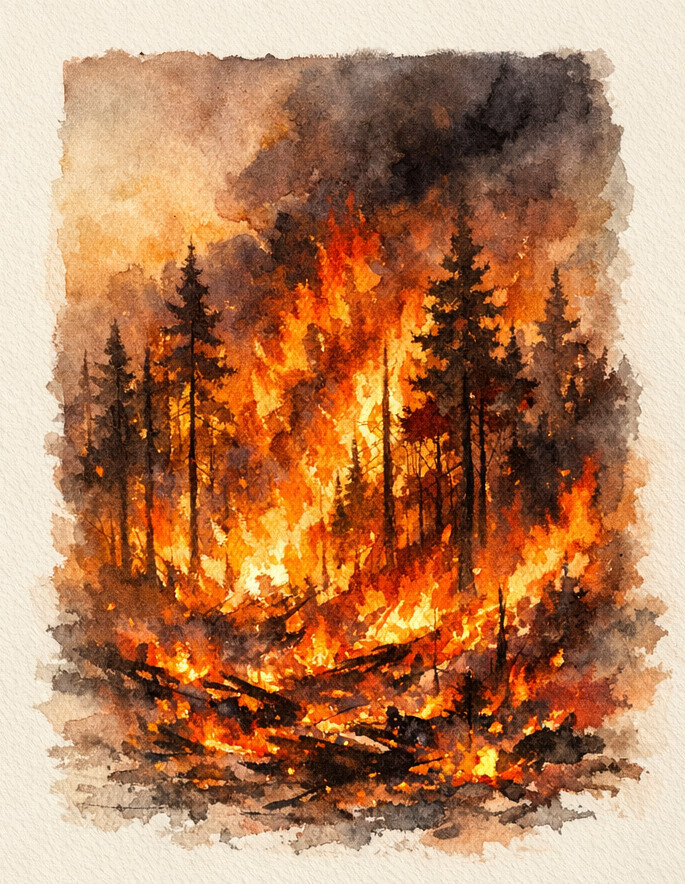
Something hit you.
Not a small thing. Something big enough that the way you normally handle life stopped working. You're reading this because you're somewhere in that.
We're not going to tell you it's going to be fine. We don't know that yet. What we can tell you is that you have more to work with than it currently feels like - and that the first job is to find out exactly what that is.
The stack collapses from the top.
When something big lands, it doesn't take everything at once. It takes the top first.
Resilience goes. You can't sustain what you can't process. Then resourcefulness - the ability to see options and move - gets buried under the weight of what just happened. Then curiosity dies. You stop asking questions because the answers have been terrifying you. Then observation narrows - tunnel vision sets in and you stop seeing what's actually there. And if it goes far enough, openness closes entirely - you stop receiving anything, from anyone.
Your skills and knowledge don't leave you the same way. They're still in there. But they're inaccessible when the inner stack has collapsed - a skilled person in full shutdown can't deploy what they know. The inner states have to come back online first.
That's not weakness. That's a predictable sequence. And a predictable sequence can be reversed.
The question isn't why did this happen. The question is: where in the stack did you lose the thread?
Start where you actually are.
Not where you wish you were. Not where you were six months ago. Where you are right now.
Can you stay open to the possibility that there is a way through this? If yes - you have the bottom of the stack. Work from there.
Can you observe what you have? Not what you've lost. What remains. What's still functional. What's still available. If yes - you have two layers.
Can you get curious about what's actually in front of you - not what you fear is coming, but what is concretely present? If yes - you have three layers.
From three layers, resourcefulness starts to become possible again. Not full resourcefulness. Not the version of you that was handling life smoothly. But enough to take one angle of attack on one piece of this.
That's all we're after right now. One angle. One piece.
On going it alone.
The third resource - the one most people lean on hardest in hard seasons - is other people.
We have to be honest with you: if what broke was a relationship, or if what broke was trust, you may have to rebuild the first two rungs before the third one is available again. That's not a permanent condition. It's a sequencing reality.
Money and time are largely yours to manage. Relationships require someone else to be willing. If that willingness isn't there right now, the answer isn't to force it. The answer is to work with what you have until the ground is stable enough that the relational dimension can be rebuilt on something real.
You're not failing by going it partially alone. You're sequencing correctly.
What resourcefulness looks like from zero.
It doesn't look like brilliance. It doesn't look like the person who always seems to have an answer.
It looks like asking one question you haven't asked yet.
It looks like looking at what you have instead of cataloguing what you don't.
It looks like trying the obvious thing you've been too overwhelmed to try.
It looks like noticing that the door you've been pushing opens the other way.
The spark is there. It's been there since you were a child asking why about everything. It got covered over - by the size of this, by what came before this, by years of having the wrong conditions for it to breathe.
We're here to help you uncover it. Not manufacture it. Uncover it.
The next step is smaller than you think.
You don't need a plan. You don't need to solve the whole thing.
You need one observation about your actual situation that you haven't fully faced yet.
Start there.
Next: Triage →← Home